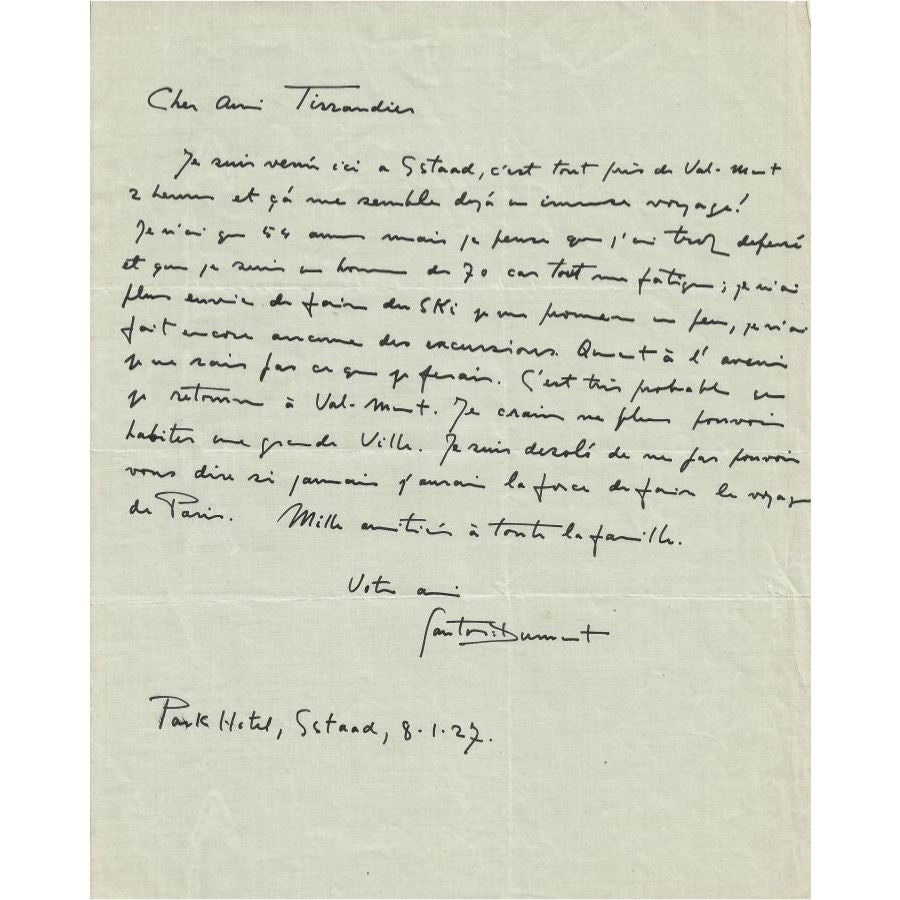
"I'm only 54 years old, but I think I've been working too hard and that I'm like a 70-year-old man because everything tires me out."
- Previously unpublished handwritten letter from Alberto Santos Dumont to Paul Tissandier.
- One page.
- In French.
- Gstaad, Switzerland.
- January 8, 1927.
- Excellent condition conservation.
- Unique piece.
Translation in Portuguese
My dear Tissandier,
I came here to Gstaad, it's near Val-Mont, and two hours already feels like a huge trip!
I'm only 54 years old, but I think I've been working too hard and that I'm like a 70-year-old man because everything tires me out: I don't feel like skiing anymore, I just go for walks a bit, I haven't done any of the excursions yet.
As for the future, I don't know what I'm going to do. It's very likely that I'll return to Val-Mont. I'm afraid I won't be able to live in a big city anymore.
I'm sorry I can't tell you if I'll have the strength to travel to Paris. Many warm wishes to the whole family.
Your friend.
Santos Dumont.
Park Hotel, Gstaad, 8.1.27
Known to Brazilians as the father of aviation, Alberto Santos Dumont (1873-1932), the first man to take off aboard an airplane powered by a gasoline engine, does not hold the same title in other countries of the world. The question of who invented the first airplane still provokes debate. The American Wright brothers have their paternity recognized in most nations. In France, for example, Clément Ader holds the honor of merit. However, if they all contributed to the history of aviation, why not share the credit for this invention? Whether it's a matter of ego or authorship, for these great geniuses, it was difficult to share the glory of their revolutionary invention.
Nevertheless, the era of pioneers came to an end, and the blow was very hard for the Brazilian aviator. Dumont's frail mental state can be perceived in the letter he wrote to his friend Tissandier, the famous inventor of engines, in 1927. By that time, our father of aviation was already in a rehabilitation clinic in Valmont, Switzerland, where he spent several years treating his psychiatric condition. In the letter, Dumont speaks of his exhaustion, and that despite being only 54 years old, he feels like a 70-year-old man, no longer having the energy for activities that previously brought him pleasure. As for the future, I don't know what to do, he said in his letters.
After years of hard work that drained his health, aviation was becoming popular, and with it, the exclusivity of its creators was disappearing. Other events further undermined the creator's self-esteem; he had to admit that the Wright brothers were the creators of the first airplane, and, moreover, he saw his great invention being used for military purposes of mass destruction in the First World War. Perhaps for this reason, Dumont, as he himself states in his letter, no longer thought of living in a big city; he was tired of the hustle and bustle.
Although the story doesn't have the happiest of endings, it is certainly a lesson. Dumont was a genius who revolutionized the world, but he couldn't control his thoughts. Whether or not he was the sole inventor of the airplane, his contribution is undeniably part of the entire human effort to fly, and it is as part of a society, not as isolated individuals, that we evolve. What would Dumont say if he knew that his invention was fundamental in spreading the health crisis we are experiencing today? But also, how many hugs, encounters, and moments of happiness has aviation brought to our lives? When we learn to share equally the glories and the calamities, we will grow collectively.
This letter announces the tragic end of Santos Dumont, whose letters, autographs, and photographs are sought after by collectors worldwide.