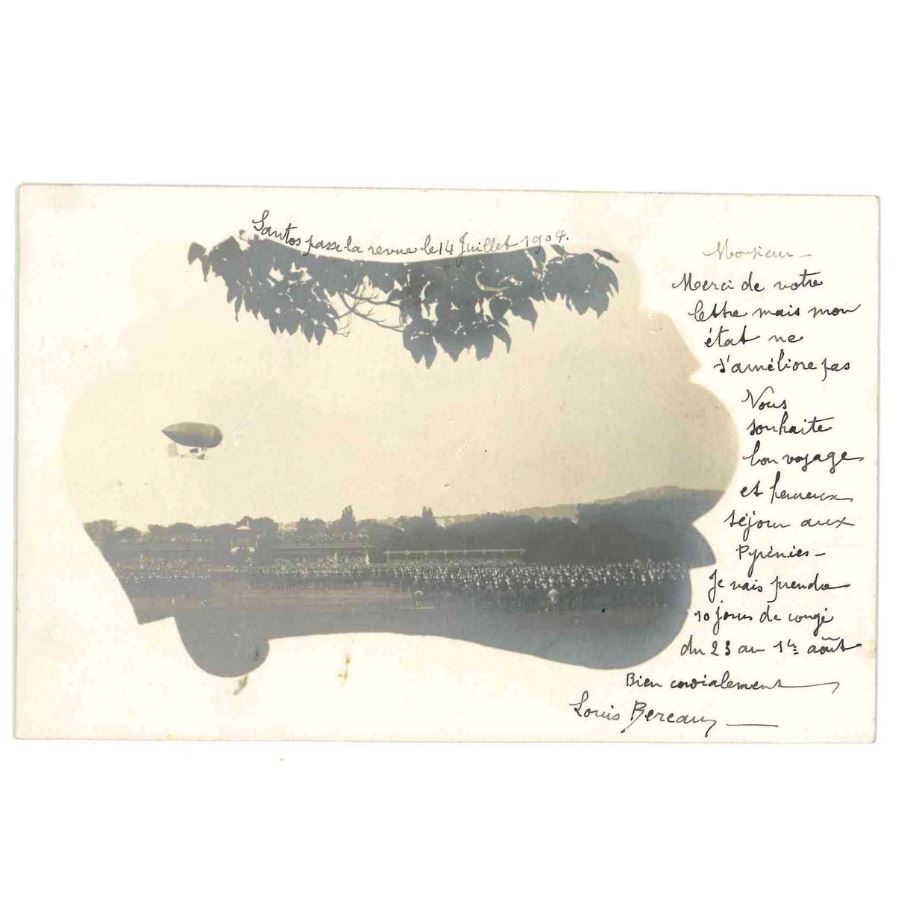
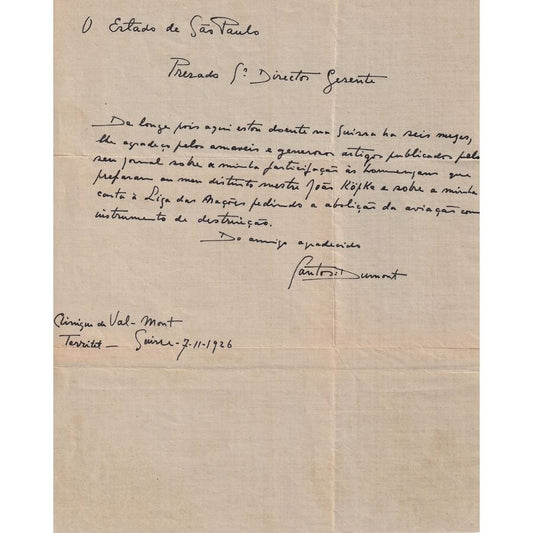
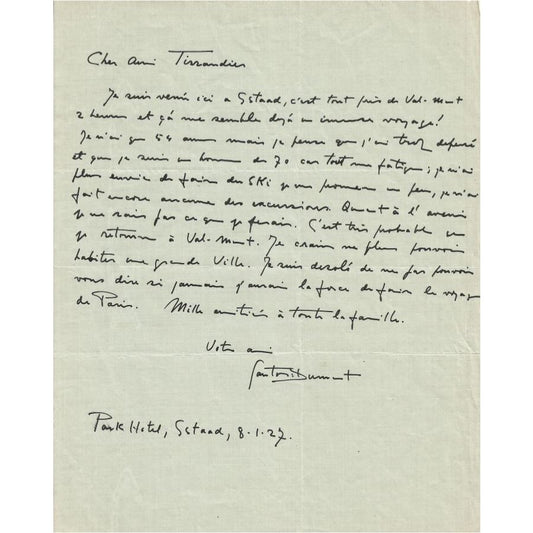
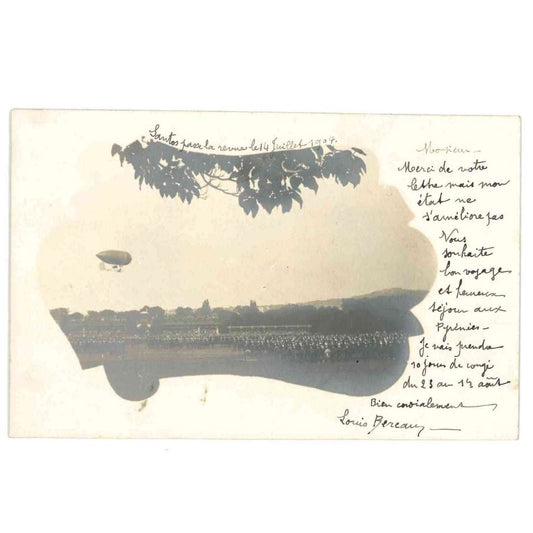
"Santos standing atop the military parade on July 14, 1904."
-
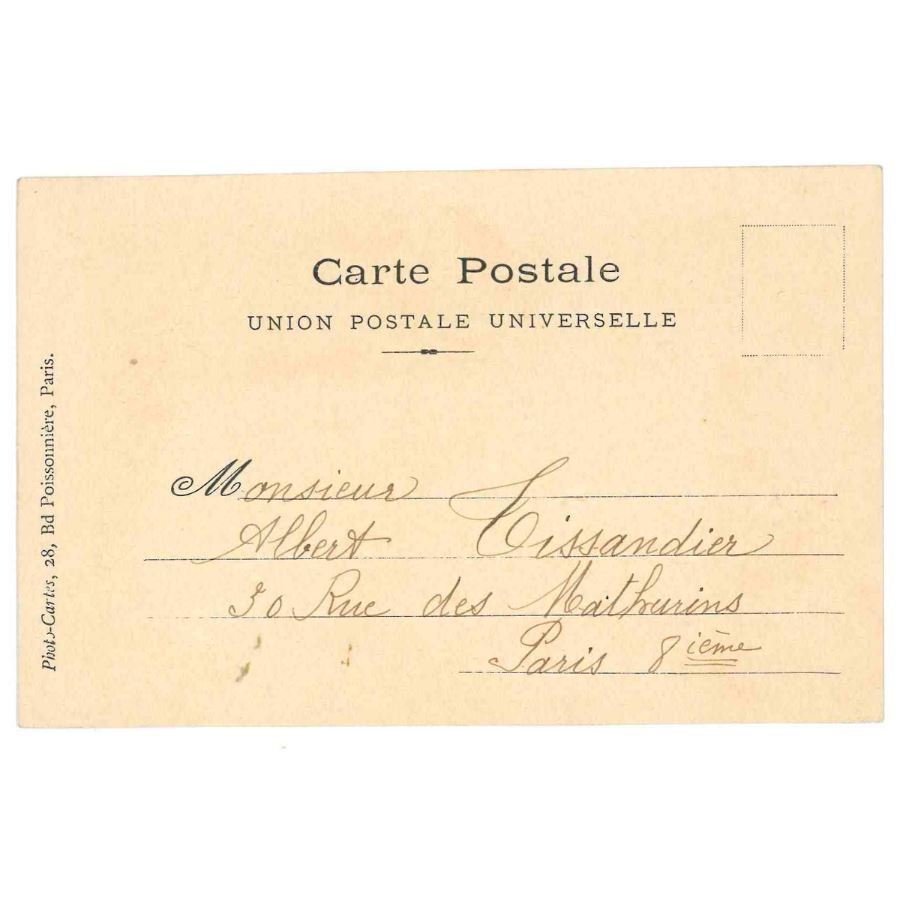
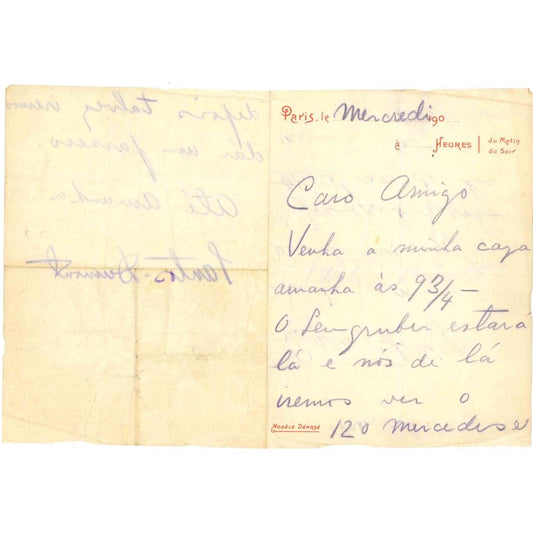
Handwritten letter from Louis Bereau to Albert Tissandier, with a period photograph in postcard format and text about Alberto Santos Dumont.
- July or August 1904, Paris.
- 14 cm x 9 cm.
- In French.
- Excellent condition conservation.
- Unique piece.
We often wonder who invented the airplane. The Wright brothers, say the Americans. The French speak of Clément Ader. Brazilians claim it was Santos Dumont. In reality, like most great inventions, there isn't a single inventor but several people who thought, experimented, failed, and achieved small victories so that finally – one day – the dream would become reality. The same is true for the invention of the automobile, the telephone, the internet, the conquest of space, etc.
Louis Bereau , the author of this letter, was well known in the aeronautical world. An influential person who frequented and supported most aviation adventurers. He had already made many flights in balloons and had an impressive collection of objects related to this subject that so inspired inventors. And in 1900, he was asked by France to present the collection at the Universal Exposition in Paris.
Albert Tissandier was the brother of Gaston Tissandier and uncle of Paul Tissandier, whom I have already introduced in other documents. The Tissandier family was famous and decisive in the world of balloons and engines, and for Santos Dumont. They were passionate about mechanics and are responsible for a series of patents and records, including the world speed record for an airplane (Paul, May 25, 1909). In fact, the pioneers of aviation were mechanics and were interested in the automobile, a recent invention. For example, the French brand Peugeot – which Brazilians know well – later financed the work of the Frenchman Etienne Oehmichen, who contributed greatly to the invention of the helicopter along with Breguet, Cornu, Pescara (a Spaniard), and others.
But the magic of rare documents often lies in the details. This is once again the case here, with this short phrase written by Louis Bereau at the top, just above the photo:
"Santos (Dumont) standing on the military parade ground on July 14, 1904."
Indeed, in this photograph we see Santos Dumont on July 14, 1904, at what appears to be number 14, in the suburbs of Paris, in St. Cloud or Bagatelle, participating in the French national holiday, the day of the storming of the Bastille during the French Revolution (July 14, 1789).
The story of Santos Dumont is linked to July 14th, France's National Day. On July 14, 1903, for the first time in the world, a flying machine participated in a military parade. And the author of this feat was Santos Dumont, with dirigible number 9, the most popular of his balloons.
One can imagine that Bereau , the Tissandiers, the French military, many important personalities, including the President of the Republic, as well as thousands of curious onlookers, would have gathered there, elegant and with their heads held high, to admire the audacity of this little Brazilian. In the letter, Bereau adds that his health was not good and, in fact, he died only a few months later, without having seen Santos Dumont fly "for real".
The document I present today is the kind of rarity I love to discover. It's a vibrant testament to this era, the late 19th and early 20th centuries, when many enthusiasts, amateurs and professionals alike, were interested in mankind's oldest dream: to fly. Primarily in Europe and America.