


Auguste Renoir's handwritten letter (1900)
Auguste Renoir's handwritten letter (1900)
Free shipping
Comes with Certificate of Authenticity and Digital Warranty ©
Couldn't load pickup availability
This item is no longer available. However, we can potentially put you in touch with its owner – who knows, they might accept your offer? – or, alternatively, suggest other items of similar interest, without any obligation. Contact us via WhatsApp: +55 31 98221-5758 or by email: contato@glorias.com.br
In 1900, the French Impressionist painter Auguste Renoir rented a house in the South of France with a list of requirements.
- Handwritten letter from Auguste Renoir to Hugues Vimeon, owner of a house.
- One page, front and back.
- In French.
- 13.5 cm x 21.4 cm.
- April 16, 1900.
- City of Grasse, France.
- Condition: fair, as the sheet is partially torn at the edges, without affecting the readability of the text.
- This unique set comes with the handwritten letter from Auguste Renoir, an explanatory letter written by the letter's heiress, and two antique postcards depicting the house mentioned in Renoir's letter.
Original transcription of the letter
Monsieur Hugues Vimeon,
Je m´engage à louer votre maison [?] au Hameau du Toulonnet á Magagnosc pour une durée de trois ans à partir du premier octobre dix neuf cent, pour la somme de huit cents francs par an, à condition que la maison soit terminée et habitable, que les plâtres soient secs, qu´il y ait une cheminée dans la salle à manger, une dans la chambre à l´est au premier étage et une dans la chambre à l´ouest au premier étage, qu´il y ait des toilettes sur le palier du premier étage, au second deux chambres de bonnes côté ouest et un atelier à l´est, avec grande fenêtre, le tout peint à la colle, un cabinet d´aisance extérieur avec entrée intérieure. De plus je m´engage à verser la somme de douze cents francs représentant une année et demi de location (payé, assigné R, de Renoir) avant le 1er octobre prochain à Monsieur Hugues Vimeon propriétaire de la dite maison.
Renoir
Artiste peintre demeurant á Paris 33 rue de Rochefoucauld
Fait à Grasse le 16 avril 1900
Translation from French to Portuguese
Senhor Hugues Vimeon,
Prometo alugar sua casa [?] no vilarejo de Toulonnet em Magagnosc por um período de três anos a partir de 1º de outubro de 1900, pela soma de oitocentos francos por ano, desde que a casa esteja concluída e habitável, que os gessos estejam secos, que haja uma chaminé na sala de jantar, uma no quarto ao leste no primeiro andar e uma no quarto ao oeste no primeiro andar, banheiros no patamar do primeiro andar, dois quartos para serviçais do lado oeste e um ateliê no leste, com uma janela grande, todas as paredes com papéis de parede, um banheiro exterior com uma entrada interna. Além disso, comprometo-me a pagar a soma de mil e duzentos francos, representando um ano e meio de aluguel (pago, assinado "R." de Renoir) antes de 1º de outubro ao Sr. Hugues Vimeon, proprietário da referida casa.
Renoir
Artista-pintor residente em Paris, 33 rua de Rochefoucauld
Feito em Grasse, 16 de abril de 1900.
Auguste Renoir (1841-1919) was one of the greatest representatives of the French Impressionist movement. A specialist in portraits and nudes, influenced mainly by the paintings of Eugène Delacroix, he also drew inspiration throughout his career from the works of Raphael, Fragonard, Courbet, and Manet. From his studies in Paris, he associated with other great names in painting, such as Monet, Bazille, and Sisley.
In the late 1860s, he often painted outdoors in the Fontainebleau forest, a habit that would mark his style and themes.
In 1877, while exhibiting for several years at the Salon des Impressionistes, Renoir painted his famous work Le Bal du Moulin de la Galette. After a period of financial difficulties, he gradually returned to portraiture, achieving great success with Déjeuner des canotiers.
In 1890, three years after the Grandes Baigneuses, he would paint, with a style varying between Impressionism and the Ingresque style, Les Jeunes Filles au piano, considered the foundational painting of this new period.
From 1900 onwards, Renoir acquired a solid reputation and exhibited his works in all European capitals. He died in 1919, recognized and accomplished. He was the father of five children, including Jean Renoir, the famous French director and screenwriter.
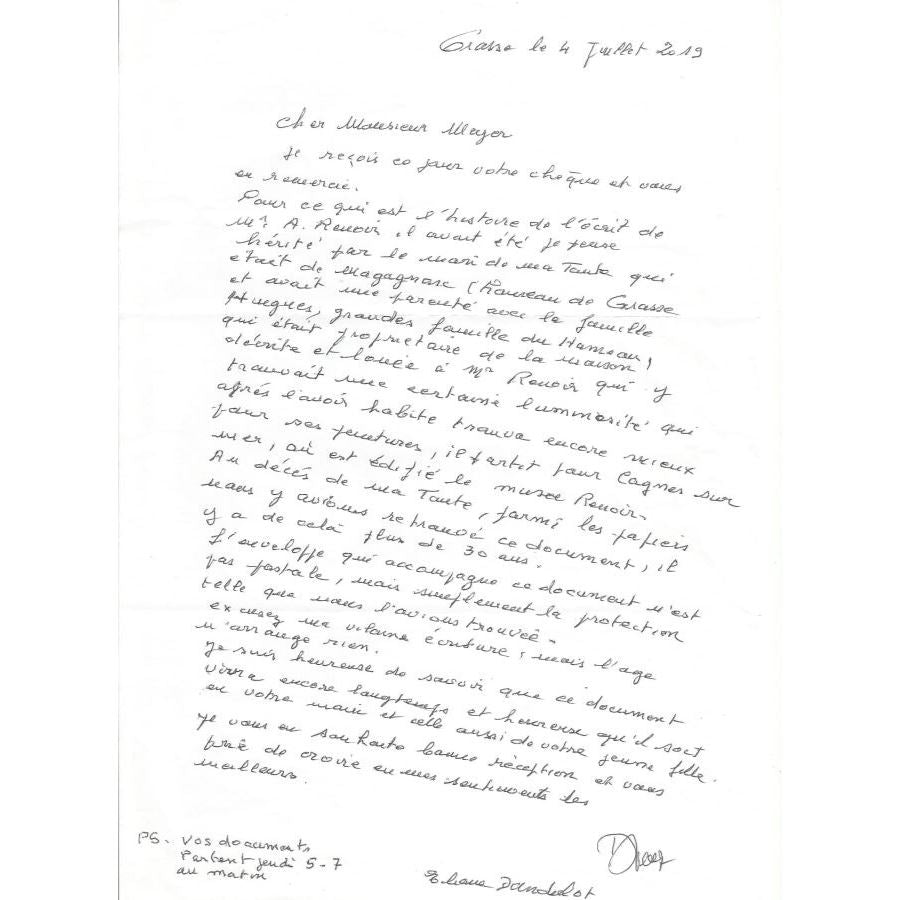
In the summer of 2018, we discovered in the South of France (in the city of Grasse) this letter – still unknown – from the French Impressionist painter Auguste Renoir. The letter's heiress, an 85-year-old French lady, wrote to us:
Grasse, July 4, 2019
(...) Regarding the history of Mr. Auguste Renoir's letter, it was inherited by my aunt's husband, born in Magagnosc (a hamlet of Grasse) who had a relationship with the Hugues family, a large family from the village, owners of the house described and rented to Mr. Renoir.
In it, he found a certain light that, after living there, he found even better for his paintings. Later, he left for Cagnes-Sur-Mer, where the Renoir Museum is built.
When my aunt died, more than 30 years ago, among the papers, we found this document (...)
When I read this letter, I found it particularly interesting that Renoir spoke about his studio: "a studio facing east, with a large window."
The listing of his demands, shown in the letter, also allows us to imagine his personality and lifestyle.
Furthermore, adding to the rarity of this document is the distinct signature: "Renoir, artist-painter residing in Paris," as most of his letters are simply signed "Renoir," and although he lived for about two years in the aforementioned house, this was a period of his life that was not well-documented.
Finally, an exciting discovery for both admirers of Renoir and enthusiasts of Impressionism.


Frequently asked questions about the GLÒRIAS COLLECTION
Is there a physical store where I can see the items in person?
No. Glórias operates exclusively online because we serve collectors throughout Brazil and also abroad. If you wish to examine an item before purchase, we will be happy to send high-resolution photographs or additional information. Our team is located in Belo Horizonte (MG).
Do the items sold come with a certificate of authenticity?
Yes. All items available at Glórias have been carefully selected, studied, and certified before being offered for sale. Each purchase comes with a digital certificate of authenticity and guarantee, which we send via email. It is signed and stamped by Mathias Meyer, a French autograph expert since 2010 and a member of the ILAB (International League of Antiquarian Booksellers).
Who selects and certifies the items sold?
All items are selected and certified by Mathias Meyer, a French specialist in autographs, manuscripts, and historical documents since 2010. Throughout his career, he has studied thousands of pieces related to Brazilian history, sports, science, literature, and arts, and is now a member of ILAB (International League of Antiquarian Booksellers) and founder of Glórias.
How do I make a purchase?
You can purchase directly from the Glórias website, 24 hours a day, quickly and securely. If you prefer personalized service or have questions before purchasing, you can also contact us by email at contato@glorias.com.br or by WhatsApp at +55 (31) 98221-5758.
What are the payment methods?
We accept payment via Pix or bank transfer, both with a 3% discount for upfront payment, as well as credit card in up to 3 interest-free installments, offering convenience and security for customers across Brazil.
Can I pay for my purchase in installments?
Yes. You can pay in full via Pix or bank transfer with a 3% discount, or pay in up to 3 interest-free installments by credit card, with immediate shipping after payment confirmation. It is also possible to pay in up to 10 installments via Pix; in this case, shipping will be carried out after the full payment of the purchase.
Can I ask for a discount?
We offer a 3% discount for payments made in full (via Pix or bank transfer) or the option to pay in up to 3 interest-free installments by credit card. Furthermore, the prices of our pieces are carefully determined based on international market supply and demand, the specific characteristics of each item, and sales results of similar pieces. For this reason, we typically do not grant additional discounts. However, if you wish to purchase multiple pieces or make an exceptionally high-value purchase, we would be pleased to consider a special commercial arrangement.
How is delivery made? What will I receive?
Delivery time varies from approximately 1 to 10 business days, depending on the recipient's location. In Brazil, we primarily use SEDEX, and for international shipments, FedEx. The document is placed in an elegant laid paper folder and sent in completely discreet packaging. The digital certificate of authenticity and guarantee is sent via email in PDF format for security reasons. Shipping is free throughout Brazil. For international shipments, the shipping cost is a fixed R$ 500.00. For some exceptionally valuable or specially sized pieces, delivery may be carried out personally by Mathias Meyer, in Brazil or abroad.
Can I return my purchase?
Yes. For online purchases, the Consumer Protection Code guarantees the right of withdrawal within 7 days of receiving the item. If you are not satisfied, simply contact us and we will respond promptly to find the best solution, which may include a full refund after the return and verification of the item.
What warranties come with the items?
All items sold by Glórias have a permanent guarantee against eventual certification errors, provided that such error is subsequently demonstrated and confirmed by Mathias Meyer. In this event, the buyer will be fully reimbursed. To date, this situation has never occurred. The guarantee does not cover natural alterations or damage caused by improper storage, exposure to light, humidity, insects, or any other external factor that may compromise the preservation of the paper or ink.
Can I resell this piece in the future?
Yes. Should you wish to sell your piece in the future, please contact us. We will be happy to guide you and help you find a new collector, either through a direct sale or through a specialized auction organized by Glórias.
How can I add value to my collection?
If your goal is to go beyond an isolated purchase, the ideal is to build a coherent collection around a theme, a personality, or a historical period, such as aviation pioneers, women who made history, love letters, old photographs of Rio de Janeiro, Oscar Niemeyer, Pelé, or Ayrton Senna. Mathias Meyer can guide you in forming a consistent collection, according to your interests, objectives, and budget.
How should I store my document or autograph?
To preserve your document in the best condition, we recommend against laminating it or keeping it permanently framed, as paper needs to breathe and prolonged exposure to light can accelerate its deterioration. Ideally, store it in a dry, dark, and clean place, protected from humidity, extreme temperatures, dust, and insects, ensuring its preservation for many decades.
Why aren't these pieces in museums?
Throughout history, much of the world's documentary heritage has been preserved thanks to private collectors and dealers. These enthusiasts of historical documents play a fundamental role in the discovery, study, and preservation of pieces that can later be loaned, donated, or sold to museums and other institutions. In Brazil, where many museums have limited financial resources and staff, this collaboration is even more important. Glórias maintains relationships with public institutions, museums, and researchers, both in Brazil and abroad, sharing discoveries, knowledge, and, in some cases, documents for exhibitions.
Can I offer you a part to buy?
With pleasure. The first step is to conduct a preliminary assessment, which will determine the level of authenticity, market value, and the best strategy for your piece. Depending on the outcome, there are several possibilities, such as certification, direct sale, consignment, or a specialized auction.
Where do the parts sold by Glórias come from?
Behind every rare document lies a unique trajectory, which makes collecting a fascinating way to preserve and transmit history. Most of the pieces offered by Glórias were inherited by families who contacted us, while others were acquired at auctions, where they were misidentified or undervalued, or came from collectors, antique dealers, or autograph document merchants.
Assine nossa newsletter
Achamos tesouros todo mês. Seja o primeiro a saber.