This item is no longer available. However, we may be able to put you in touch with its owner – who knows, they might accept your offer? – or, alternatively, suggest other items of similar interest, without any commitment. Contact us via WhatsApp: +55 31 98221-5758 or email: contato@glorias.com.br
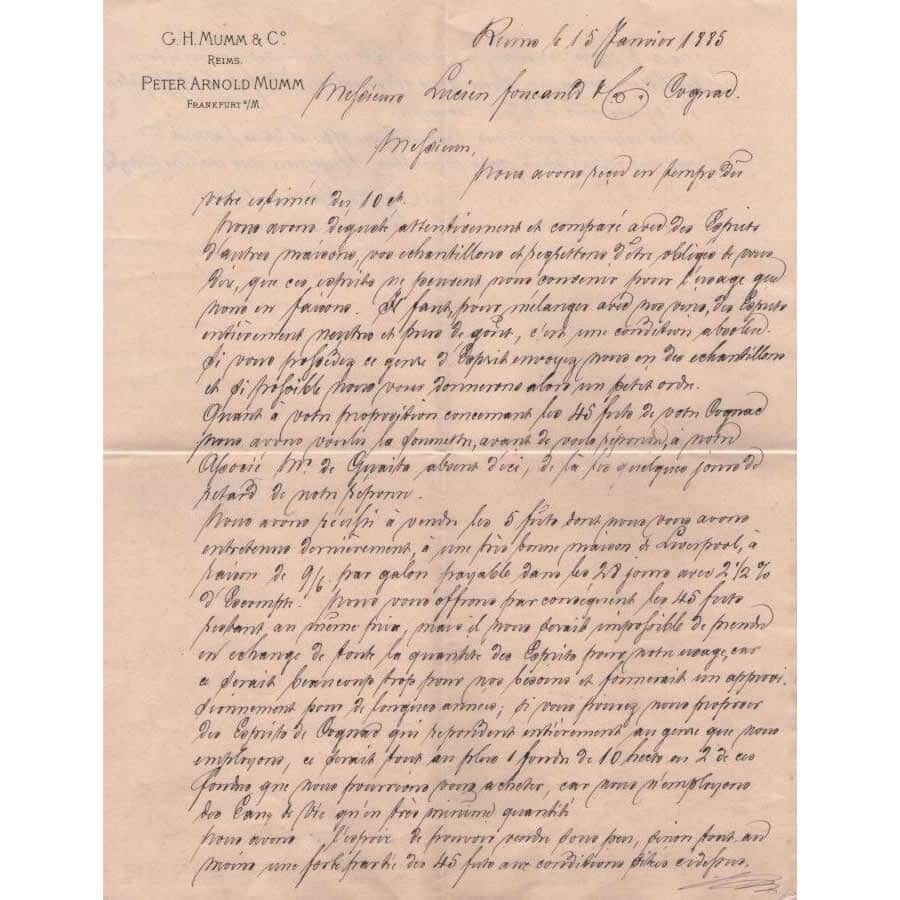
G.H. Mumm, the founder of the famous French Champagne brand from Reims, negotiates with a Cognac producer in 1885.
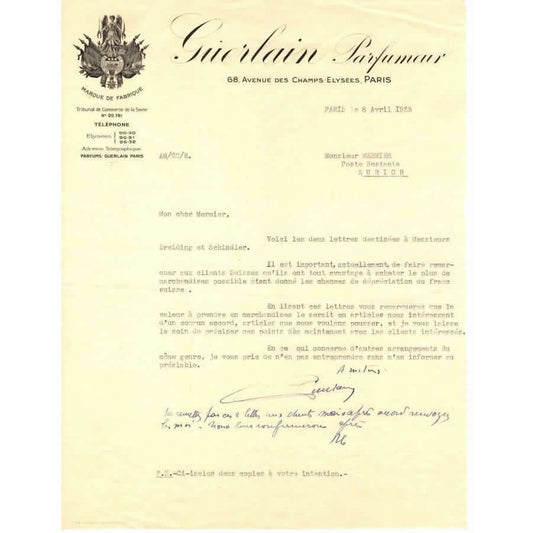
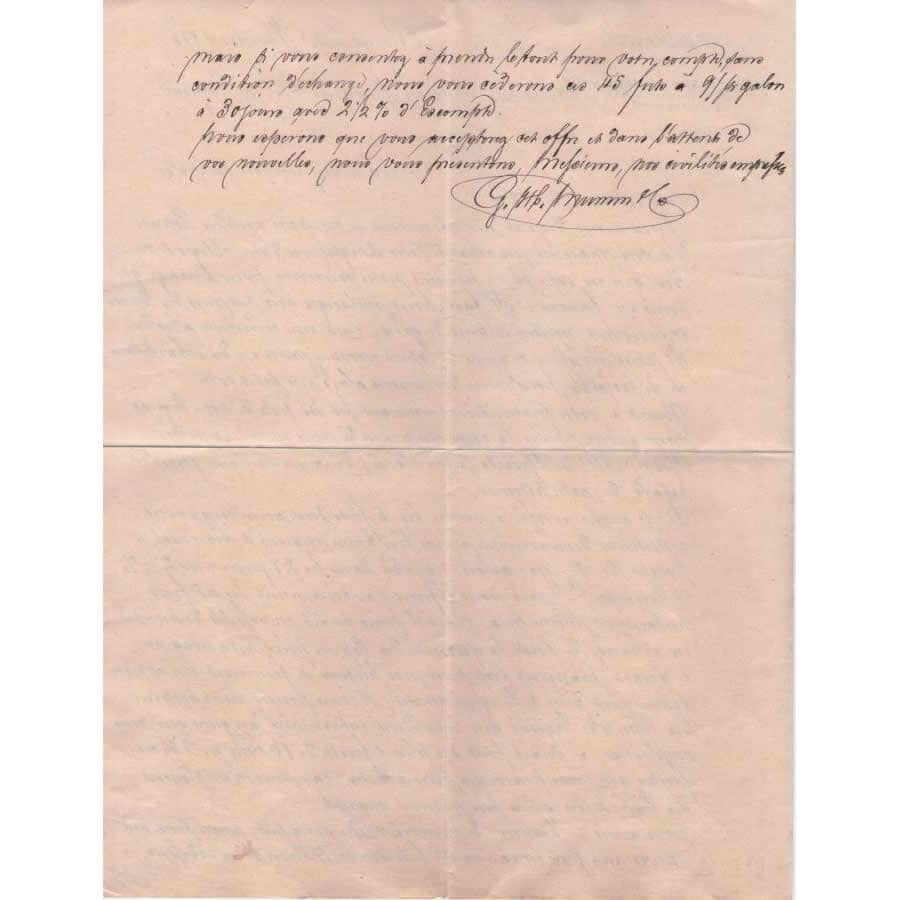
- Handwritten letter from George Hermann Mumm, owner of the famous Champagne house, to Lucien Foucault, a Cognac producer.
- Four pages (but two blank).
- In French.
- 20.7 cm x 27 cm.
- Reims (France), January 15, 1885.
- Excellent condition.
- Unique item.
Excerpts
We carefully tasted and compared your sample to the cognacs of other manufacturers, and we regret to have to tell you that your distillates are not suitable for our application. It is necessary, to be combined with our wines, that the distillate be completely neutral and pure on the palate; this is an absolute condition (...).
One of the world's leading Champagne producers, alongside Veuve Clicquot and Moët et Chandon, the G.H. Mumm house was founded in 1827. In 1853, Georges Hermann Mumm, son of the founder, gave his name to the brand and defined a commercial strategy that allowed the house to rapidly expand its cellars and buy the best vineyards. In the 1890s, Mumm Champagnes were already officially supplied to royal families in England, Sweden, Denmark, Norway, Belgium, Prussia, Austria-Hungary, the Netherlands, and Spain, as well as luxury cruises, hotels, restaurants, and clubs. Today, it is also an official sponsor of major sporting events, such as the Formula 1 and NBA world championships. The "Cordon Rouge" is a symbol of prestige and lifestyle in a hundred countries.
In this year 1885, G. H. Mumm negotiated with Lucien Foucault, owner of a respected French Cognac distillery, to buy part of his production, which would be used in the composition of the Champagnes. However, G. H. Mumm was not satisfied with the tastings and made another commercial proposal to Lucien Foucault, which seems to be the purchase of Cognac for export, another specialty of the Mumm house.
Stéphane Kraxner, head of the archives of Mumm et Perrier-Jouët companies in Reims, explains the relations between Champagne and Cognac producers at the time:
(...) Indeed, as you probably know, champagne needs to expel fermentation residues to be transferred and purified. Moreover, during this operation, some product is always lost, which is necessary to top up the bottle. While today this is done with older wines or vintage wines, this was not the case in the 19th and early 20th centuries. Most champagne houses operated their wines with a mixture of old wine and cognac spirit, which allowed them to correct very low alcohol levels in certain years. The progress of fermentation and the mastery of elaboration and champagnization methods made these techniques obsolete.
Furthermore, Cognac houses and Champagne houses found it beneficial to be represented by the same people in the markets: both beverages representing French luxury. Finally, the merger of the LVMH group (Moët et Chandon and Hennessy) led to another similar rapprochement, like Pernod-Ricard or the Martell Mumm Perrier-Jouët subsidiary, bringing together both products under a common luxury goods management (…).
Handwritten by G.H. Mumm himself, with beautiful calligraphy and a prestigious signature, this letter is particularly valuable for lovers of French wines, Champagnes, and Cognacs.

 Sold out
 Sold out