


Handwritten letter from Vinicius de Moraes (1954)
Handwritten letter from Vinicius de Moraes (1954)
Free shipping
Comes with Certificate of Authenticity and Digital Warranty ©
Couldn't load pickup availability
This item is no longer available. However, we may be able to put you in touch with its owner — who knows, they might accept your offer? — or, alternatively, suggest other items of similar interest, without any obligation. Please contact us via WhatsApp: +55 31 98221-5758 or email: contato@glorias.com.br
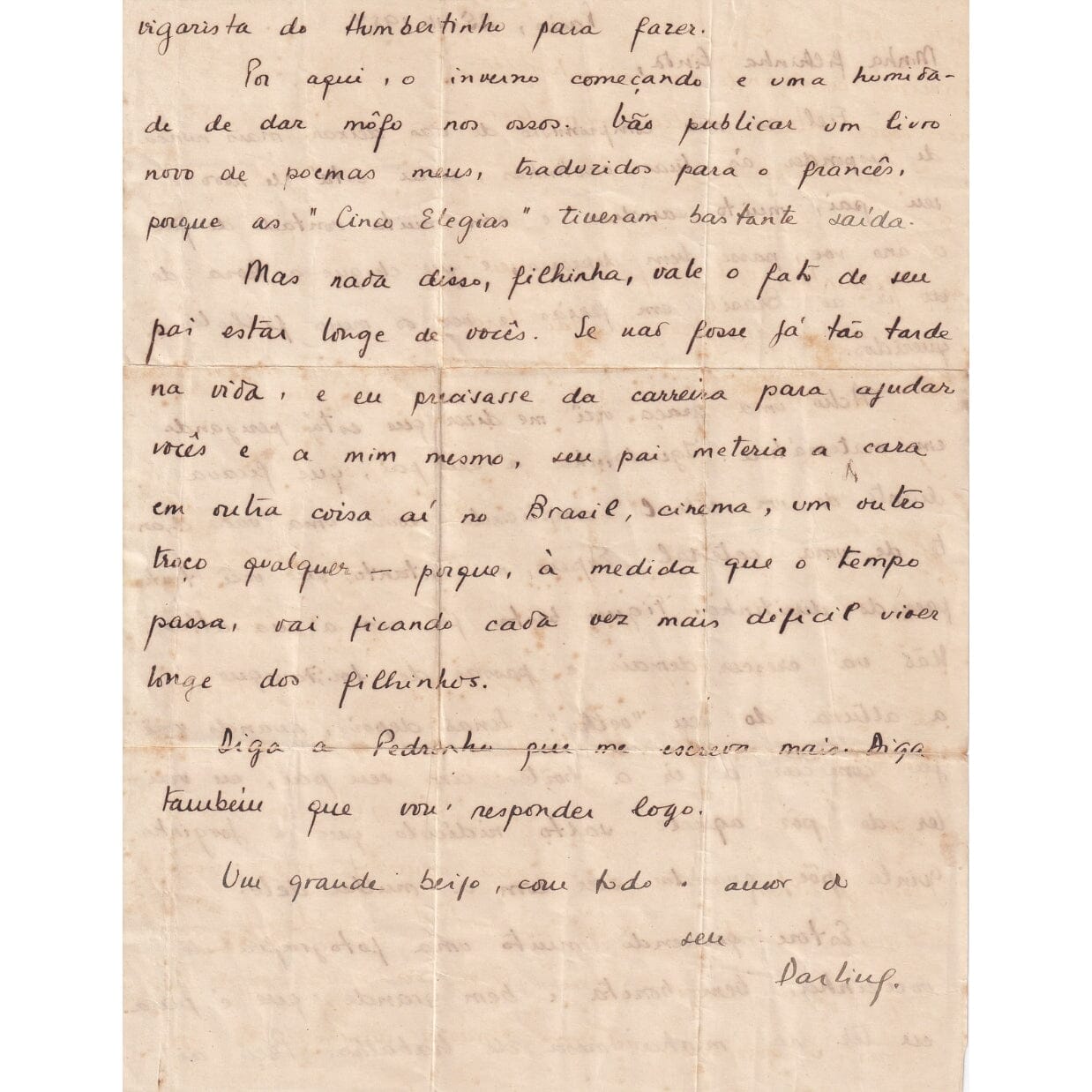
In 1954, Vinicius de Moraes shares with his daughter his longing and reflections on his career in Paris.
- Letter from Vinicius de Moraes to his first daughter, Susana de Moraes.
- One sheet, two pages.
- In Portuguese.
- 20.9 cm x 27.1 cm.
- Paris, November 25, 1954.
- Excellent condition.
- Unique piece.
Excerpts
(...) I find it amusing that you tell me you're struggling in math. Just like your father, who would face a complicated calculation like a cow facing a cathedral.
(...) I was stunned by your height. Don't grow too much and exceed 1m70, which is your "old man's" height. Otherwise, later, when you start going to nightclubs with your father, I'll have to wear those ridiculous heels that Jorginho Guiné wears when he goes out with his wife.
(...) I will soon publish a new book of my poems, translated into French, because "Cinco Elegias" sold quite well.
(...) But none of this, my dear daughter, is worth the fact that your father is far from you all. If it weren't so late in life, and I needed my career to help you and myself, your father would throw himself into something else there in Brazil, cinema, or anything else, because, as time goes on, it becomes increasingly difficult to live far from my children.
In 1954, Vinicius de Moraes was living in Paris, working at the Brazilian embassy. This period of his life was significant, as he was in a phase of artistic transition. After publishing important works such as Cinco Elegias and Poemas, Sonetos e Baladas, he released his Antologia Poética and the award-winning play Orfeu da Conceição. During his stay in the French capital, Vinicius also began to collaborate with the young pianist Tom Jobim, which would later result in one of the most iconic partnerships in Brazilian music. Despite his diplomatic responsibilities, his passion for poetry and music continued to flourish.
Vinicius's relationship with his first daughter, Susana, was marked by deep longing and affection, a mutual admiration that lasted until Vinicius's death. Later, Susana often reflected on how her father's work influenced her life, music, literature, and Brazil. She was likely the person who best understood the artist's complexity, both in his achievements and his vulnerabilities.
This letter is exceptional for being handwritten, extensive, in perfect condition, and, above all, for having very personal and profound content. One only needs to read it to enter Vinicius's world, this Brazilian genius recognized worldwide not only as the co-author — with Tom Jobim — of "Garota de Ipanema," but, more broadly, as one of the inventors of Bossa Nova and a great playwright. The "Darling" signature at the end, a nickname Susana gave Vinicius, is the icing on the cake.

Frequently asked questions about the GLÒRIAS COLLECTION
Is there a physical store where I can see the items in person?
No. Glórias operates exclusively online because we serve collectors throughout Brazil and also abroad. If you wish to examine an item before purchase, we will be happy to send high-resolution photographs or additional information. Our team is located in Belo Horizonte (MG).
Do the items sold come with a certificate of authenticity?
Yes. All items available at Glórias have been carefully selected, studied, and certified before being offered for sale. Each purchase comes with a digital certificate of authenticity and guarantee, which we send via email. It is signed and stamped by Mathias Meyer, a French autograph expert since 2010 and a member of the ILAB (International League of Antiquarian Booksellers).
Who selects and certifies the items sold?
All items are selected and certified by Mathias Meyer, a French specialist in autographs, manuscripts, and historical documents since 2010. Throughout his career, he has studied thousands of pieces related to Brazilian history, sports, science, literature, and arts, and is now a member of ILAB (International League of Antiquarian Booksellers) and founder of Glórias.
How do I make a purchase?
You can purchase directly from the Glórias website, 24 hours a day, quickly and securely. If you prefer personalized service or have questions before purchasing, you can also contact us by email at contato@glorias.com.br or by WhatsApp at +55 (31) 98221-5758.
What are the payment methods?
We accept payment via Pix or bank transfer, both with a 3% discount for upfront payment, as well as credit card in up to 3 interest-free installments, offering convenience and security for customers across Brazil.
Can I pay for my purchase in installments?
Yes. You can pay in full via Pix or bank transfer with a 3% discount, or pay in up to 3 interest-free installments by credit card, with immediate shipping after payment confirmation. It is also possible to pay in up to 10 installments via Pix; in this case, shipping will be carried out after the full payment of the purchase.
Can I ask for a discount?
We offer a 3% discount for payments made in full (via Pix or bank transfer) or the option to pay in up to 3 interest-free installments by credit card. Furthermore, the prices of our pieces are carefully determined based on international market supply and demand, the specific characteristics of each item, and sales results of similar pieces. For this reason, we typically do not grant additional discounts. However, if you wish to purchase multiple pieces or make an exceptionally high-value purchase, we would be pleased to consider a special commercial arrangement.
How is delivery made? What will I receive?
Delivery time varies from approximately 1 to 10 business days, depending on the recipient's location. In Brazil, we primarily use SEDEX, and for international shipments, FedEx. The document is placed in an elegant laid paper folder and sent in completely discreet packaging. The digital certificate of authenticity and guarantee is sent via email in PDF format for security reasons. Shipping is free throughout Brazil. For international shipments, the shipping cost is a fixed R$ 500.00. For some exceptionally valuable or specially sized pieces, delivery may be carried out personally by Mathias Meyer, in Brazil or abroad.
Can I return my purchase?
Yes. For online purchases, the Consumer Protection Code guarantees the right of withdrawal within 7 days of receiving the item. If you are not satisfied, simply contact us and we will respond promptly to find the best solution, which may include a full refund after the return and verification of the item.
What warranties come with the items?
All items sold by Glórias have a permanent guarantee against eventual certification errors, provided that such error is subsequently demonstrated and confirmed by Mathias Meyer. In this event, the buyer will be fully reimbursed. To date, this situation has never occurred. The guarantee does not cover natural alterations or damage caused by improper storage, exposure to light, humidity, insects, or any other external factor that may compromise the preservation of the paper or ink.
Can I resell this piece in the future?
Yes. Should you wish to sell your piece in the future, please contact us. We will be happy to guide you and help you find a new collector, either through a direct sale or through a specialized auction organized by Glórias.
How can I add value to my collection?
If your goal is to go beyond an isolated purchase, the ideal is to build a coherent collection around a theme, a personality, or a historical period, such as aviation pioneers, women who made history, love letters, old photographs of Rio de Janeiro, Oscar Niemeyer, Pelé, or Ayrton Senna. Mathias Meyer can guide you in forming a consistent collection, according to your interests, objectives, and budget.
How should I store my document or autograph?
To preserve your document in the best condition, we recommend against laminating it or keeping it permanently framed, as paper needs to breathe and prolonged exposure to light can accelerate its deterioration. Ideally, store it in a dry, dark, and clean place, protected from humidity, extreme temperatures, dust, and insects, ensuring its preservation for many decades.
Why aren't these pieces in museums?
Throughout history, much of the world's documentary heritage has been preserved thanks to private collectors and dealers. These enthusiasts of historical documents play a fundamental role in the discovery, study, and preservation of pieces that can later be loaned, donated, or sold to museums and other institutions. In Brazil, where many museums have limited financial resources and staff, this collaboration is even more important. Glórias maintains relationships with public institutions, museums, and researchers, both in Brazil and abroad, sharing discoveries, knowledge, and, in some cases, documents for exhibitions.
Can I offer you a part to buy?
With pleasure. The first step is to conduct a preliminary assessment, which will determine the level of authenticity, market value, and the best strategy for your piece. Depending on the outcome, there are several possibilities, such as certification, direct sale, consignment, or a specialized auction.
Where do the parts sold by Glórias come from?
Behind every rare document lies a unique trajectory, which makes collecting a fascinating way to preserve and transmit history. Most of the pieces offered by Glórias were inherited by families who contacted us, while others were acquired at auctions, where they were misidentified or undervalued, or came from collectors, antique dealers, or autograph document merchants.
Assine nossa newsletter
Achamos tesouros todo mês. Seja o primeiro a saber.