Skip to product information
1 of 1

Drawings and notes by Eugênio de Proença Sigaud (1944)

Drawings and notes by Eugênio de Proença Sigaud (1944)

Regular price R$ 0,00 BRL
Regular price Sale price R$ 0,00 BRL
Sale Sold out
Shipping calculated at checkout.

Free shipping

Comes with Certificate of Authenticity and Digital Warranty ©

> This item is no longer in the catalog, see available documents here <

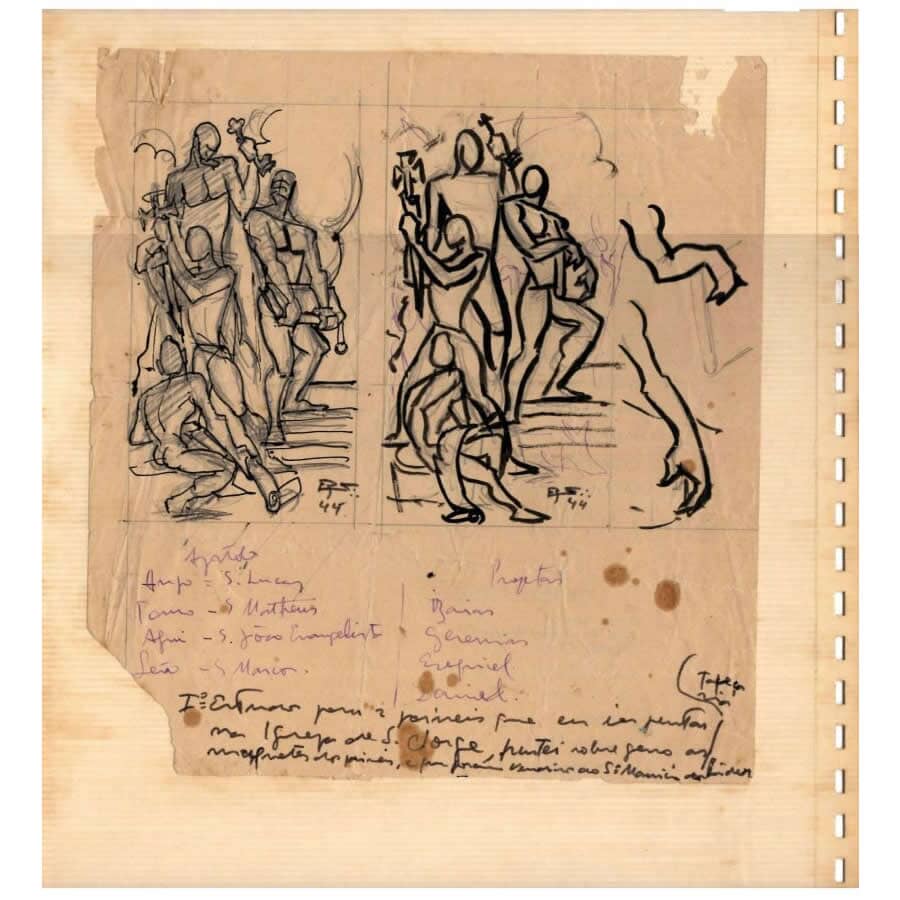
Sketch of panels of the famous São Jorge church, in Rio de Janeiro, by the artist Eugênio de Proença Sigaud.

  • Drawings and notes by Eugênio de Proença Sigaud.
  • One page.
  • In Portuguese.
  • 26.5 cm x 32.5 cm outside, 21.5 cm x 23.4 cm inside.
  • No location information, 1944.
  • Glued and protected by a film, excellent condition of conservation.
  • Unique piece.

Apostles

Angel – Saint Luke
Taurus – Saint Matthew
Eagle – Saint John the Evangelist
Leo – Saint Mark

Prophets

Isaiah
Jeremiah
Ezekiel
Daniel

1st = [Mats] for two panels that I will paint
in the Church of São Jorge, I painted the tapestries on iron
in front of the panels they will venerate Saint Maurice [the leader]

Painter, engraver, graphic artist, illustrator, set designer, critic, teacher, architect and poet... Eugênio de Proença Sigaud (1899 - 1979) from Minas Gerais is known as the painter of workers, exploring in his canvases and murals, in an intense and militant way, a clearly social theme. He represented the worker in his productive context, amidst the constructions with iron, concrete and scaffolding structures, typical of construction sites, but also on the street, amidst traffic, in factories, railways, bridges, shipyards and, later, moving from the city to the countryside. He worked with the architect Lúcio Costa in 1931, was part of the Portinari Group in 1935, supported the communist candidate Carlos Prestes in 1946 and produced numerous important works, exhibited in Brazil and abroad.

"I am a communist and an engineer. I have always dealt with workers, which explains my choice of themes. I have always been aware of the social role of art. I have always been involved in politics. In my opinion, everything serves political interests. However, freedom of creation is fundamental." And also, about his painting: "it has never been a gratuitous act, not even my architecture. It is, above all, a conscious and firm attitude, a purpose with artistic, political and social objectives. With it, I celebrate, especially, the magnitude and greatness of the humble work of the worker, this anonymous worker in all sectors of the greatness of the Fatherland." (MORAES, 1979).

The document presented here is a preparatory work for the stained glass windows of the Church of São Jorge, in Rio de Janeiro. The Church of São Jorge is known for its celebrations of the Holy Warrior Day (April 23) in honor of Saint George, with the participation of half a million people in the week-long celebrations every April. There are lectures, shows, a theater, fireworks and, afterwards, a mass with Dom Orani. The tributes take place in several other locations in Rio de Janeiro.

Saint George is one of the most venerated saints in Catholicism and is immortalized in the legend of his slaying of the dragon. Legend has it that Saint George was a soldier and was tortured by the Roman Emperor Diocletian around 302 AD (after Christ) to convert him. Since he did not renounce Christianity, he was beheaded on April 23, 303 AD. The number of miracles attributed to Saint George is immense. According to tradition, he protects and favors all who turn to him with faith and devotion, winning battles, lawsuits, persecutions and injustices.

Sigaud produced many drawings during his lifetime, but this document, of one of his best-known works, presents a sketch in excellent condition and illuminating commentary by the artist himself.

View full details

Frequently asked questions about the GLÒRIAS COLLECTION

Is there a physical store where I can see the items in person?

No. Glórias operates exclusively online because we serve collectors throughout Brazil and also abroad. If you wish to examine an item before purchase, we will be happy to send high-resolution photographs or additional information. Our team is located in Belo Horizonte (MG).

Do the items sold come with a certificate of authenticity?

Yes. All items available at Glórias have been carefully selected, studied, and certified before being offered for sale. Each purchase comes with a digital certificate of authenticity and guarantee, which we send via email. It is signed and stamped by Mathias Meyer, a French autograph expert since 2010 and a member of the ILAB (International League of Antiquarian Booksellers).

Who selects and certifies the items sold?

All items are selected and certified by Mathias Meyer, a French specialist in autographs, manuscripts, and historical documents since 2010. Throughout his career, he has studied thousands of pieces related to Brazilian history, sports, science, literature, and arts, and is now a member of ILAB (International League of Antiquarian Booksellers) and founder of Glórias.

How do I make a purchase?

You can purchase directly from the Glórias website, 24 hours a day, quickly and securely. If you prefer personalized service or have questions before purchasing, you can also contact us by email at contato@glorias.com.br or by WhatsApp at +55 (31) 98221-5758.

What are the payment methods?

We accept payment via Pix or bank transfer, both with a 3% discount for upfront payment, as well as credit card in up to 3 interest-free installments, offering convenience and security for customers across Brazil.

Can I pay for my purchase in installments?

Yes. You can pay in full via Pix or bank transfer with a 3% discount, or pay in up to 3 interest-free installments by credit card, with immediate shipping after payment confirmation. It is also possible to pay in up to 10 installments via Pix; in this case, shipping will be carried out after the full payment of the purchase.

Can I ask for a discount?

We offer a 3% discount for payments made in full (via Pix or bank transfer) or the option to pay in up to 3 interest-free installments by credit card. Furthermore, the prices of our pieces are carefully determined based on international market supply and demand, the specific characteristics of each item, and sales results of similar pieces. For this reason, we typically do not grant additional discounts. However, if you wish to purchase multiple pieces or make an exceptionally high-value purchase, we would be pleased to consider a special commercial arrangement.

How is delivery made? What will I receive?

Delivery time varies approximately from 1 to 10 business days, depending on the recipient's location. In Brazil, we mainly use SEDEX, and for international shipments, FedEx. The document is placed in an elegant laid paper folder and sent in completely discreet packaging. The digital certificate of authenticity and guarantee is sent by email, in PDF format, for security reasons. Shipping is free throughout Brazil. For international shipments, the shipping cost is a fixed R$ 500.00.

Can I return my purchase?

Yes. For online purchases, the Consumer Protection Code guarantees the right of withdrawal within 7 days of receiving the item. If you are not satisfied, simply contact us and we will respond promptly to find the best solution, which may include a full refund after the return and verification of the item.

What warranties come with the items?

All items sold by Glórias have a permanent guarantee against eventual certification errors, provided that such error is subsequently demonstrated and confirmed by Mathias Meyer. In this event, the buyer will be fully reimbursed. To date, this situation has never occurred. The guarantee does not cover natural alterations or damage caused by improper storage, exposure to light, humidity, insects, or any other external factor that may compromise the preservation of the paper or ink.

Can I resell this piece in the future?

Yes. Should you wish to sell your piece in the future, please contact us. We will be happy to guide you and help you find a new collector, either through a direct sale or through a specialized auction organized by Glórias.

How can I add value to my collection?

If your goal is to go beyond an isolated purchase, the ideal is to build a coherent collection around a theme, a personality, or a historical period, such as aviation pioneers, women who made history, love letters, old photographs of Rio de Janeiro, Oscar Niemeyer, Pelé, or Ayrton Senna. Mathias Meyer can guide you in forming a consistent collection, according to your interests, objectives, and budget.

How should I store my document or autograph?

To preserve your document in the best condition, we recommend against laminating it or keeping it permanently framed, as paper needs to breathe and prolonged exposure to light can accelerate its deterioration. Ideally, store it in a dry, dark, and clean place, protected from humidity, extreme temperatures, dust, and insects, ensuring its preservation for many decades.

Why aren't these pieces in museums?

Throughout history, much of the world's documentary heritage has been preserved thanks to private collectors and dealers. These enthusiasts of historical documents play a fundamental role in the discovery, study, and preservation of pieces that can later be loaned, donated, or sold to museums and other institutions. In Brazil, where many museums have limited financial resources and staff, this collaboration is even more important. Glórias maintains relationships with public institutions, museums, and researchers, both in Brazil and abroad, sharing discoveries, knowledge, and, in some cases, documents for exhibitions.

Can I offer you a part to buy?

With pleasure. The first step is to conduct a preliminary assessment, which will determine the level of authenticity, market value, and the best strategy for your piece. Depending on the outcome, there are several possibilities, such as direct sale, consignment, or a specialized auction.

Where do the parts sold by Glórias come from?

Every document has a unique story. Most of the pieces offered by Glórias were inherited from families who contacted us, while others were acquired at auctions, where they were poorly identified or undervalued, or came from antique dealers, collectors, or companies. Behind every rare document there is a singular trajectory, which makes collecting a fascinating way to preserve and transmit history.