Benedito Calixto depicts the pillory of the old Praça do Rossio, in Rio de Janeiro, based on a work by Debret.
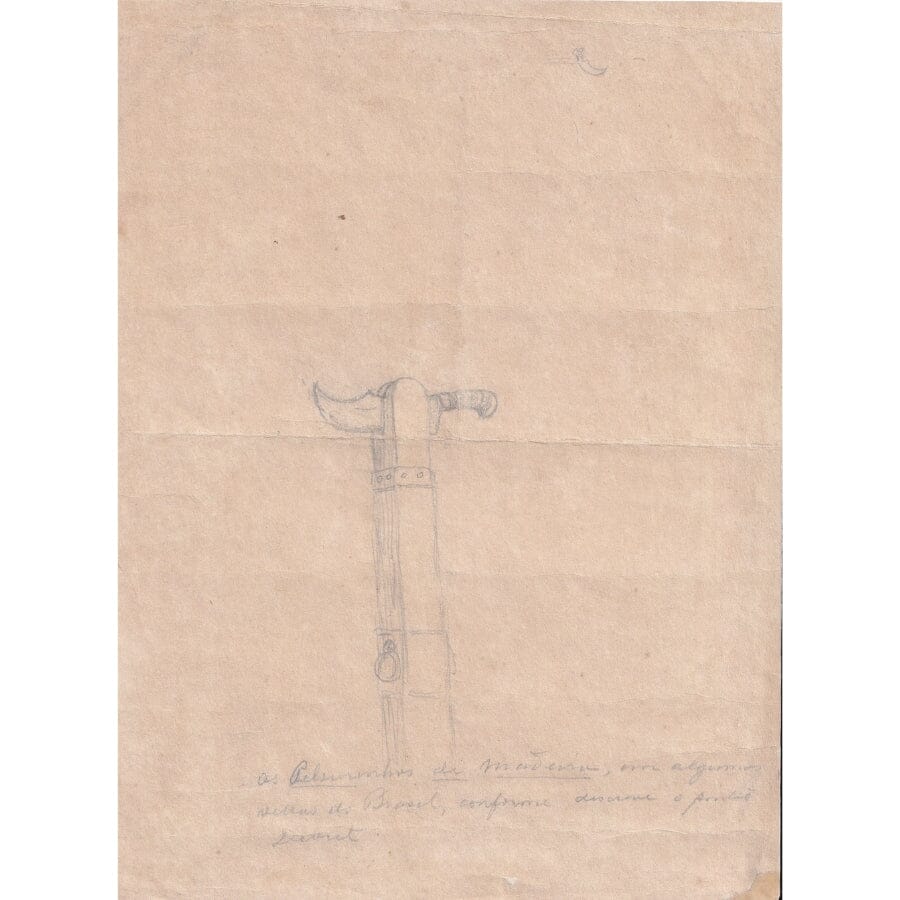
- Pencil drawing and text by Benedito Calixto about the pillory in Rio de Janeiro, inspired by Debret.
- A sheet of paper with two pages, front and back.
- 28.5 cm x 21.5 cm.
- In French.
- Good state of preservation.
- One-of-a-kind.
Front transcription
RIO DE JANEIRO'S OLD TOWN
IN THE OLD ROSSIO SQUARE (drawing by the painter DEBRET)
What is immediately noticeable in Praça do Rocio, one of the oldest squares in Rio de Janeiro, is the granite column topped with a gilded copper armillary sphere. Two small iron posts rest on the column's capital, clearly indicating the presence of a gallows – a symbol of the high justice exercised by the city government.
This emblem (designed by Debret) is found in all inland cities of Brazil, but is generally represented in a very rudimentary way, by means of a large wooden trunk painted red and two pointed pieces of iron, intended to suggest a huge cleaver. These irons, placed horizontally near the center and covered with wood, form a small cross: one of them extends as if it were the handle, and the other, fixed vertically with firmness, is firmly attached to the top of the posts.
(A Picturesque Journey to Brazil, Volume III)
Transcription of the verse
The wooden pillories in some villages of Brazil, as depicted by the painter Debret.
This antique sheet features a very delicate pencil drawing of the pillory of Rio de Janeiro, located in the old Praça do Rocio (current Praça Tiradentes). In the center, a slender granite column rises, crowned by a gilded copper armillary sphere, a symbol of Portuguese royal power, flanked by small iron posts reminiscent of the gallows. The drawing is sober, but detailed enough to suggest the relief and imposing nature of the structure, while some sketched human figures in the background give a sense of scale. Below, a handwritten caption in Portuguese indicates that it is a drawing by the painter Debret, famous for recording life in 19th-century Brazil. The lower part of the sheet is occupied by a slightly faded handwritten text in French, describing the symbolic function of the monument and recalling its presence in other Brazilian cities as a mark of colonial judicial power.
Benedito Calixto (1853-1927), one of Brazil's great historical painters, produced this study based on the work of Debret. He had the habit of copying Debret and Rugendas to document architectural and social elements of colonial Brazil. Calixto painted numerous colonial and historical scenes, but most of his large compositions are related to São Vicente, Santos, São Paulo, and the São Paulo coast; as far as is known, no finished painting by Calixto directly depicts the pillory of Rio de Janeiro. Therefore, this work is probably a preparatory exercise, an archive copy, or a documentary plate, not intended for a final painting.
This sheet is of great historical and documentary importance, as it was created by Benedito Calixto, one of the greatest historical painters in Brazil, based on the work of Debret. It was most likely produced between 1895 and 1915, a period in which Benedito Calixto dedicated himself to projects of historical memory, consulted Debret's works, and produced documentary studies for his compositions and institutional commissions. It accurately depicts the pillory of the old Praça do Rossio in Rio de Janeiro, a symbolic monument of the colonial period that no longer exists. The rarity of the piece lies in the combination of the meticulous drawing and the explanatory text handwritten in French, highlighting Calixto's direct access to original sources and his concern for preserving the visual memory of the country. It is a unique testament to his practice as an artist and researcher, uniting art and historical scholarship in an exceptional medium, difficult to find in both private collections and institutional archives.


 Sold out